The term SSF Salary refers to the salary-based contribution system under Nepal’s Social Security Fund (SSF) — a government-mandated scheme that requires both employers and employees to set aside a fixed percentage of the employee’s basic salary every month. If you’re an employee trying to understand why a chunk of your paycheck disappears into “SSF deduction,” or an employer trying to run payroll correctly, this guide walks through everything: contribution rates, salary ceilings, calculation examples, registration, benefits, and frequently asked questions.
Nepal’s formal labor market underwent a major shift when the Contribution-Based Social Security Act, 2074 (2017) came into force, replacing the older, fragmented system of Provident Fund (PF), gratuity, and informal insurance arrangements with a single, unified fund. Today, understanding “SSF salary” is essential for anyone working in, or hiring within, Nepal’s formal private sector.
Table of Contents
What Is SSF (Social Security Fund)?
The Social Security Fund, known in Nepali as Samajik Suraksha Kosh, is a government body established to collect monthly contributions from registered employers and employees and use that pooled money to provide social protection benefits. These benefits include medical treatment coverage, maternity protection, accident and disability compensation, survivor benefits for dependent family members, and — the largest component by far — an old-age retirement fund that replaces the traditional Provident Fund and gratuity system.
In simple terms, SSF salary contributions are a mandatory monthly “tax-like” deduction, but unlike a tax, the money is not spent by the government — it accumulates in an individual account tied to the employee, similar to a provident fund, along with insurance-style protections layered on top.
Legal Basis of SSF
SSF operates under a specific legal framework:
- Contribution-Based Social Security Act, 2074 (2017) — the primary law establishing the fund and its mandate
- Contribution-Based Social Security Regulations, 2075 (2018) — the regulations that define the exact contribution rates and schemes (particularly Schedule 1 and Rule 17)
- Labour Act, 2074 (2017) — which makes SSF enrollment compulsory for formal-sector employers and links it to broader labor rights
Together, these laws form the backbone of what most people simply refer to as “SSF salary rules.”
Who Must Register for SSF?
SSF registration and contribution are not optional for most formal businesses in Nepal. Here’s how applicability breaks down:
- Mandatory for private-sector employers and public enterprises employing staff under a formal employment relationship. Many sources note that once an employer has even a handful of staff on payroll, registration becomes a legal obligation, and larger employers (traditionally cited as those with 10 or more employees) face the strictest enforcement.
- Voluntary for self-employed individuals, informal-sector workers, and certain other categories who are not part of a standard employer-employee relationship. These individuals can still register and contribute both the “employee” and “employer” portions themselves to access SSF benefits.
- Excluded or handled separately are government employees who are already covered under other pension and benefit schemes (such as the civil service pension system), and certain categories of workers who fall under the Employees Provident Fund (EPF) or Citizen Investment Trust (CIT) during a transition period.
Once an employer registers with SSF, every eligible employee’s basic salary becomes subject to the SSF salary deduction and matching employer contribution described below.
SSF Salary Contribution Rate: The 31% Breakdown
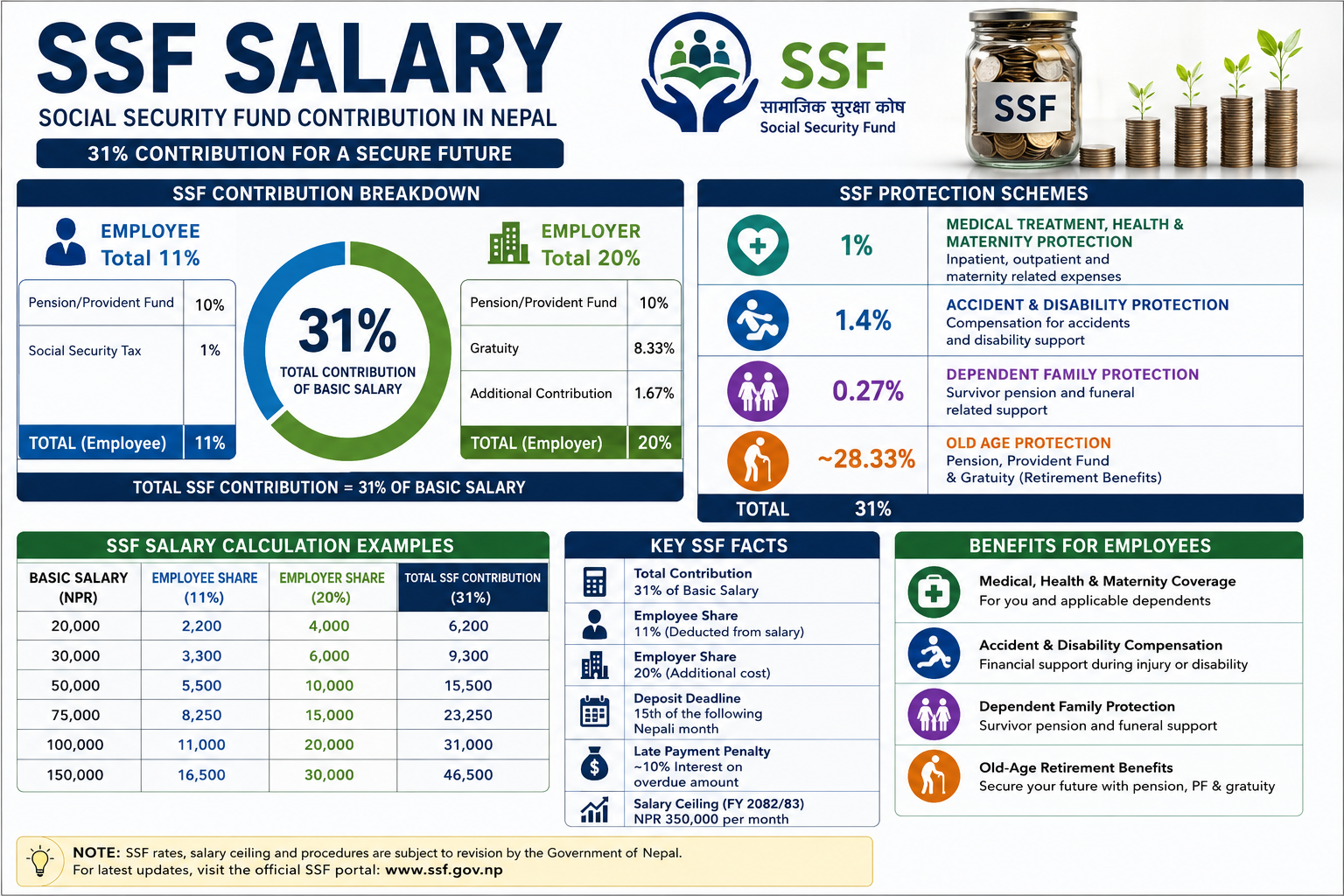
This is the number most people searching for “SSF salary” actually want: the total monthly contribution to SSF is 31% of the employee’s basic salary. This 31% is not paid by one party alone — it is split between the employee and the employer.
| Contributor | Contribution Heading | Rate (% of Basic Salary) |
|---|---|---|
| Employee | Pension/Provident Fund | 10% |
| Employee | Social Security Tax | 1% |
| Employee Total | 11% | |
| Employer | Pension/Provident Fund | 10% |
| Employer | Gratuity | 8.33% |
| Employer | Additional Contribution | 1.67% |
| Employer Total | 20% | |
| Grand Total to SSF | 31% |
A few important clarifications about how this table works in practice:
- The 11% employee share is deducted directly from the employee’s basic salary before it is credited to their bank account — this is the portion that shows up as a line-item deduction on a payslip.
- The 20% employer share is an additional cost borne by the company on top of the employee’s gross salary. It is not subtracted from what the employee would otherwise take home; it is extra money the employer contributes on the employee’s behalf.
- Contributions are calculated strictly on basic salary, not on gross salary or total compensation. Since Nepal’s Labour Rules generally require basic salary to be at least 60% of gross salary, this distinction matters significantly for take-home pay calculations.
Where the 31% Actually Goes: The Four Protection Schemes
The pooled 31% SSF salary contribution isn’t dumped into one undifferentiated account. It funds four distinct protection schemes, each covering a different type of risk or life event:
| Protection Scheme | Approximate Share of Salary | Purpose |
|---|---|---|
| Medical Treatment, Health & Maternity Protection | 1% | Inpatient care, outpatient (OPD) treatment, maternity-related expenses |
| Accident and Disability Protection | 1.4% | Compensation for workplace and other accidents, disability support |
| Dependent Family Protection | 0.27% | Survivor pension and funeral-related support for dependents |
| Old Age Protection (Pension/Provident Fund + Gratuity) | ~28.33% | Retirement savings, combining provident fund and gratuity equivalents |
| Total | 31% | Full social security package |
Notice how heavily weighted the system is toward retirement savings. Of the full 31%, roughly 28.33 percentage points — nearly 92% of the entire contribution — flows into the Old Age Protection Scheme. This scheme effectively absorbs what used to be two separate obligations under the old labor law regime: the 10%+10% Provident Fund and the 8.33% gratuity. The remaining schemes (medical, accident, and dependent family protection) together account for under 3% of salary, which is why some describe SSF less as an “insurance fund” and more as “a retirement fund with a modest insurance package attached.”
SSF Salary Calculation: Worked Examples
Numbers make more sense with real examples. Below are a few common salary calculation scenarios under the SSF salary system.
Example 1: Basic Salary of NPR 30,000
| Contributor | Rate | Amount (NPR) |
|---|---|---|
| Employee contribution | 11% | 3,300 |
| Employer contribution | 20% | 6,000 |
| Total monthly contribution to SSF | 31% | 9,300 |
In this example, the employee sees NPR 3,300 deducted from their basic salary each month, while the employer separately contributes NPR 6,000 on the employee’s behalf. The full NPR 9,300 goes into the SSF account under that employee’s name.
Example 2: Gross Salary of NPR 200,000 (60% Basic)
For higher earners, it helps to separate gross salary from basic salary, since SSF is calculated only on the basic component.
| Salary Component | Amount (NPR) |
|---|---|
| Gross monthly salary | 200,000 |
| Basic salary (60% of gross) | 120,000 |
| Allowances (remaining 40%) | 80,000 |
| Employee SSF contribution (11% of basic) | 13,200 |
| Employer SSF contribution (20% of basic) | 24,000 |
| Total monthly SSF contribution | 37,200 |
Here, the employee’s payslip shows a deduction of NPR 13,200, while the company incurs an additional NPR 24,000 in employer-side cost — money that does not reduce the employee’s gross pay but is a real cost to the business.
Example 3: Quick Reference Table for Common Basic Salaries
| Basic Salary (NPR) | Employee Share (11%) | Employer Share (20%) | Total SSF Contribution (31%) |
|---|---|---|---|
| 20,000 | 2,200 | 4,000 | 6,200 |
| 30,000 | 3,300 | 6,000 | 9,300 |
| 50,000 | 5,500 | 10,000 | 15,500 |
| 75,000 | 8,250 | 15,000 | 23,250 |
| 100,000 | 11,000 | 20,000 | 31,000 |
| 150,000 | 16,500 | 30,000 | 46,500 |
This table gives a quick way to estimate SSF salary deductions and total contributions at various basic salary levels without doing manual math each time.
The Salary Ceiling for SSF Contributions
SSF contributions aren’t calculated on an unlimited basic salary figure — there’s a ceiling above which additional salary is not subject to SSF contribution. According to recent updates, this ceiling has been revised upward: for the Nepali fiscal year 2082/83, the maximum salary considered for SSF contribution purposes has been raised from NPR 300,000 to NPR 350,000 per month. This means that even if an employee’s basic salary exceeds this threshold, the SSF contribution is calculated only up to the ceiling amount, not on the full basic salary.
This ceiling matters most for senior executives and high-earning professionals, whose basic salaries may otherwise exceed the threshold. Employers should periodically check the latest ceiling figure on the official SSF portal, since these limits are subject to revision in line with fiscal policy changes.
SSF vs. Old Provident Fund and Gratuity System
One of the most common points of confusion for both employers and employees is how the new SSF salary system relates to the older statutory framework. Before SSF, most formal-sector employees were entitled to:
- A Provident Fund contribution of 10% from the employee and 10% from the employer, deposited with an approved fund (often the Employees Provident Fund, EPF)
- A Gratuity payment, calculated separately and typically paid out as a lump sum at the end of employment, equivalent to roughly 8.33% of basic salary accrued over the employment period
Under the SSF regime, for employers who have registered their staff with the SSF, this older structure is replaced. The 20% employer contribution to SSF is structured specifically to absorb the 8.33% gratuity obligation and the 10% employer PF contribution, while adding a further 1.67% “additional contribution” that funds the broader protection schemes. In other words, SSF is designed to be a consolidated replacement, not an extra burden layered on top of the old system — though in practice, employers going through the transition need to carefully reconcile old gratuity/PF liabilities with new SSF obligations.
Government employees who are already covered under pensionable civil service arrangements, along with certain categories of voluntary EPF or CIT contributors, may continue under those older systems during a transition period rather than shifting immediately to SSF.
How SSF Salary Deductions Are Processed: The Employer’s Role
For payroll administrators and business owners, understanding the mechanics of how SSF salary deductions flow through the system is essential for compliance.
Step 1: Registration
An employer must first register the business and its employees on the official SSF portal. This involves submitting company details, employee lists, and salary structures.
Step 2: Monthly Calculation
Each month, payroll must calculate:
- 11% of each employee’s basic salary as the employee’s contribution (to be deducted from their pay)
- 20% of each employee’s basic salary as the employer’s contribution (an additional cost to the business)
Step 3: Deduction and Filing
The employer deducts the 11% employee share at the time of salary disbursement and combines it with the 20% employer share. This combined 31% figure is then filed and reported through the SSF’s online portal.
Step 4: Deposit Within the Deadline
The full monthly SSF contribution must be deposited within a strict deadline — 15 days after the end of the relevant Nepali calendar month. For example, contributions relating to the Nepali month of Baisakh must be deposited by the 15th of Jestha (the following month).
Step 5: Penalty for Late Deposit
Missing the deposit deadline is not a minor administrative lapse. Employers who fail to deposit contributions on time face an interest charge, commonly cited at around 10%, on the overdue amount. This is designed to strongly discourage delayed compliance, since SSF benefits are tied to timely, verifiable contribution records for each employee.
Table Summary: Key SSF Salary Facts at a Glance
| Aspect | Detail |
|---|---|
| Governing law | Contribution-Based Social Security Act, 2074 (2017) |
| Regulations | Contribution-Based Social Security Regulations, 2075 (2018) |
| Total contribution rate | 31% of basic salary |
| Employee share | 11% (10% pension + 1% social security tax) |
| Employer share | 20% (10% pension + 8.33% gratuity + 1.67% additional) |
| Calculation base | Basic salary only (not gross salary) |
| Minimum basic salary requirement | At least 60% of gross salary (per Labour Rules) |
| Salary ceiling (FY 2082/83) | NPR 350,000 per month |
| Deposit deadline | 15th of the following Nepali month |
| Late payment penalty | Approximately 10% interest on overdue amount |
| Mandatory for | Formal private-sector employers and public enterprises |
| Voluntary for | Self-employed individuals, informal-sector workers |
| Number of protection schemes | 4 (Medical/Maternity, Accident/Disability, Dependent Family, Old Age) |
Benefits Employees Receive Through SSF Salary Contributions
Paying into SSF isn’t a one-way deduction — it entitles registered employees to a range of protections and benefits, including:
- Medical, health, and maternity coverage, covering inpatient treatment, outpatient consultations, and maternity-related medical expenses for the employee (and in some cases, dependents)
- Accident and disability compensation, providing financial support if an employee is injured or disabled, whether the incident occurs at the workplace or elsewhere
- Dependent family protection, which offers survivor pension benefits and funeral-related support to an employee’s family in the event of the employee’s death
- Old-age retirement benefits, the largest component, functioning much like a provident fund that accumulates over an employee’s working life and becomes accessible upon retirement or under specific withdrawal conditions
Because contributions are tracked under an individual’s SSF account (rather than pooled anonymously), employees can generally check their accumulated balance and contribution history through the official SSF portal, similar to how one might check a provident fund balance.
Common Questions About SSF Salary
Is the SSF salary deduction the same as income tax?
No. SSF contributions and income tax are entirely separate deductions. Income tax is calculated according to Nepal’s income tax slabs and is paid to the government’s general revenue. SSF contributions, by contrast, are paid into an individual’s dedicated social security account and are meant to fund future benefits for that specific employee — they are not government revenue in the same sense as tax.
Does SSF salary contribution reduce my take-home pay?
Yes, partially. The 11% employee contribution is deducted from your basic salary before it reaches your bank account, so your net take-home pay is reduced by that amount. However, the 20% employer contribution does not come out of your salary — it’s an additional cost the employer pays into your SSF account.
Can an employee opt out of SSF once their employer is registered?
Generally, no. Once an employer is registered under SSF and an employee falls under the formal employment relationship covered by the Social Security Act, participation becomes compulsory rather than optional. Opting out is typically not permitted for employees whose employer is legally required to register them.
What happens to SSF contributions if I change jobs?
Since SSF accounts are tied to the individual employee (often via a unique SSF ID), contributions generally continue accumulating in that same account even when switching employers, as long as the new employer is also registered and continues making contributions on the employee’s behalf.
How is basic salary different from gross salary for SSF purposes?
Gross salary includes basic salary plus various allowances (housing, transport, dearness allowance, and so on). SSF contributions are calculated only on the basic salary component, not the full gross figure. Since Labour Rules require basic salary to be at least 60% of gross, most employees will have SSF calculated on a meaningfully large share of their total pay, even though it excludes allowances.
Is there a minimum basic salary below which SSF doesn’t apply?
The core requirement is that any formal employee under a registered employer is subject to SSF contribution regardless of how small the basic salary is, as long as the employment relationship is formal. There isn’t a broadly publicized minimum threshold below which contributions are waived — the main threshold that matters is the upper salary ceiling, not a lower one.
Practical Tips for Employers Managing SSF Salary Compliance
For businesses navigating SSF salary obligations, a few practical habits go a long way toward staying compliant:
- Automate the 31% calculation within payroll software so the 11%/20% split is applied consistently to every employee’s basic salary each pay cycle.
- Track the Nepali calendar deadline carefully — since the 15-day deposit window is based on the Nepali month, not the Gregorian calendar, it’s easy to miscalculate deadlines if you’re only tracking Western dates.
- Reconcile transition-period liabilities for any employees who were previously covered under standalone PF and gratuity arrangements before the company registered with SSF, to avoid double payment or gaps in coverage.
- Monitor the salary ceiling annually, since the government periodically revises the maximum salary figure used for SSF calculation, and using an outdated ceiling can lead to under- or over-contribution.
- Keep employees informed about their SSF contributions and how to check their account balance, since transparency reduces confusion around payslip deductions.
Conclusion
“SSF Salary” ultimately refers to the mandatory 31% monthly contribution — split as 11% from the employee and 20% from the employer — that funds Nepal’s Social Security Fund. This single contribution replaces the older, fragmented system of separate provident fund and gratuity payments, consolidating them alongside medical, accident, and survivor protections into one unified scheme. For employees, it means a modest but meaningful deduction from basic salary in exchange for a broader safety net covering health, disability, and retirement. For employers, it means a clear, calculable payroll obligation with strict registration, calculation, and deposit requirements under the Contribution-Based Social Security Act, 2074.
Whether you’re checking your own payslip or setting up payroll for a growing team, understanding the SSF salary structure — the 31% total, the 11%/20% split, the four protection schemes, and the salary ceiling — is the foundation for staying compliant and making sense of where that portion of your salary actually goes.
Note: SSF contribution rates, salary ceilings, and procedures are subject to periodic government revision. For the most current figures and official registration procedures, refer to the official SSF portal (ssf.gov.np) or consult a qualified labor law professional in Nepal.
