The State Reserve Police Force (SRPF) is one of the most respected paramilitary wings under the Maharashtra Police, responsible for maintaining law and order, handling riot control, VIP security, and anti-terrorism operations across the state. For thousands of young aspirants preparing for state-level police recruitment exams every year, SRPF salary is one of the most searched and most important pieces of information before applying. This guide breaks down everything you need to know about SRPF salary in 2026 — from basic pay and in-hand salary to allowances, deductions, rank-wise pay scales, and long-term career growth.
Table of Contents
What Is SRPF and Why Does Its Salary Matter?
SRPF stands for State Reserve Police Force, a specialized armed police force that operates under the Maharashtra Home Department. Unlike regular civil police, SRPF personnel are trained for high-intensity situations such as riot control, bandobast during large public events, counter-insurgency operations, and providing security in sensitive or high-risk zones.
Because the job demands physical fitness, discipline, and a willingness to be posted anywhere in the state (and sometimes outside it), the SRPF salary structure includes several risk-related and hardship-related allowances that regular administrative government jobs do not offer. This makes understanding the complete salary breakdown — not just the basic pay — essential for anyone evaluating whether an SRPF career is the right fit.
Key Responsibilities of SRPF Personnel
- Maintaining law and order during riots, protests, and civil unrest
- Providing security cover during elections, festivals, and VIP movements
- Anti-Naxal and counter-insurgency operations in sensitive districts
- Disaster management and relief support during natural calamities
- Guarding sensitive government installations and border areas within the state
SRPF Salary Structure 2026: Basic Pay Overview
The SRPF salary is determined according to the 7th Pay Commission, which Maharashtra state government employees follow. The starting position — SRPF Constable — falls under Pay Level 3 (sometimes referenced as Pay Level S-7 in the Maharashtra pay matrix).
| Salary Component | Amount (Approximate) |
|---|---|
| Basic Pay (starting) | ₹21,700 per month |
| Basic Pay (maximum with experience) | ₹69,100 per month |
| Dearness Allowance (DA) | Approx. 50% of basic pay |
| House Rent Allowance (HRA) | 10% to 30% of basic pay (city-dependent) |
| Travel & Ration Allowance | ₹2,000 – ₹8,000 |
| Medical Allowance | ₹500 (approx.) |
| Gross Salary | ₹38,000 – ₹48,000 |
| In-Hand Salary (after deductions) | ₹30,000 – ₹45,000 |
Since basic pay is the foundation on which most allowances are calculated, even a small increase in basic pay through annual increments translates into a proportionally larger increase in the total take-home salary.
SRPF Constable Salary: Detailed Monthly Breakdown
For most aspirants, the constable-level salary is the number that matters the most, since it represents the entry point into the force. Below is a more granular breakdown of what a typical SRPF Constable’s monthly payslip looks like.
| Component | Description | Approximate Amount |
|---|---|---|
| Basic Pay | Fixed starting salary under Pay Level 3 | ₹21,700 |
| Dearness Allowance (DA) | Adjusted periodically based on inflation, roughly half of basic pay | ₹8,500 – ₹10,850 |
| House Rent Allowance (HRA) | Varies by posting location (urban postings attract higher HRA) | ₹2,000 – ₹4,000 |
| Travel Allowance (TA) | Covers commuting and field deployment costs | ₹1,500 – ₹2,500 |
| Ration/Kit Allowance | Since SRPF personnel are often deployed away from home, ration support is provided | ₹1,000 – ₹3,000 |
| Medical Allowance | Basic healthcare support allowance | ₹500 |
| Gross Monthly Salary | Sum of basic pay and all allowances | ₹38,000 – ₹48,000 |
| Deductions (NPS, Insurance, Professional Tax) | Statutory and welfare deductions | ₹3,000 – ₹6,000 |
| Net In-Hand Salary | Amount credited to the bank account | ₹30,000 – ₹45,000 |
It’s worth noting that these figures can vary slightly depending on the specific SRPF Group/Battalion, the district of posting, and whether the individual is deployed on special duty that attracts additional risk allowance.
SRPF Training Period Salary
Before being confirmed into their post, SRPF recruits undergo a rigorous training period that typically lasts several months. During this phase, the salary structure is slightly different from that of a confirmed constable.
- Basic Pay During Training: ₹21,700 (same as the starting basic pay)
- Dearness Allowance: Applicable at the prevailing rate
- HRA and Field Allowances: Generally not activated until after official posting is confirmed
- Risk/Special Duty Pay: Not applicable during the training phase
This means the in-hand salary during training is typically lower than what a fully posted constable receives, since several allowances only kick in once the recruit completes training and receives an official field posting.
Rank-Wise SRPF Salary Structure
SRPF, like other police forces, follows a hierarchical rank structure, and salary increases significantly with each promotion. The table below outlines the approximate pay scale, grade pay, and total salary (including allowances) for each rank.
| Rank | Pay Scale (Approx.) | Grade Pay | Total Salary (Including Allowances) |
|---|---|---|---|
| Constable | ₹21,700 – ₹69,100 | ₹2,000 | ₹30,000 – ₹40,000 |
| Head Constable | ₹25,500 – ₹81,100 | ₹2,400 | ₹35,000 – ₹45,000 |
| Assistant Sub-Inspector (ASI) | ₹29,200 – ₹92,300 | ₹2,800 | ₹40,000 – ₹50,000 |
| Sub-Inspector (SI) | ₹35,400 – ₹1,12,400 | ₹4,200 | ₹50,000 – ₹65,000 |
| Inspector | ₹44,900 – ₹1,42,400 | ₹4,600 | ₹60,000 – ₹80,000 |
| Assistant Commissioner of Police (ACP) | ₹56,100 – ₹1,77,500 | ₹5,400 | ₹75,000 – ₹95,000 |
| Deputy Commissioner of Police (DCP) | ₹67,700 – ₹2,08,700 | ₹6,600 | ₹90,000 – ₹1,10,000 |
How Grade Pay Affects Total Compensation
Grade pay is an additional fixed component added on top of the basic pay scale, and it plays a role in determining eligibility for certain allowances and pension calculations. As personnel move up the ranks — from Constable to Head Constable, and eventually to gazetted officer ranks like ACP and DCP — both the basic pay band and the grade pay increase substantially, which is reflected in the much higher total compensation for senior ranks.
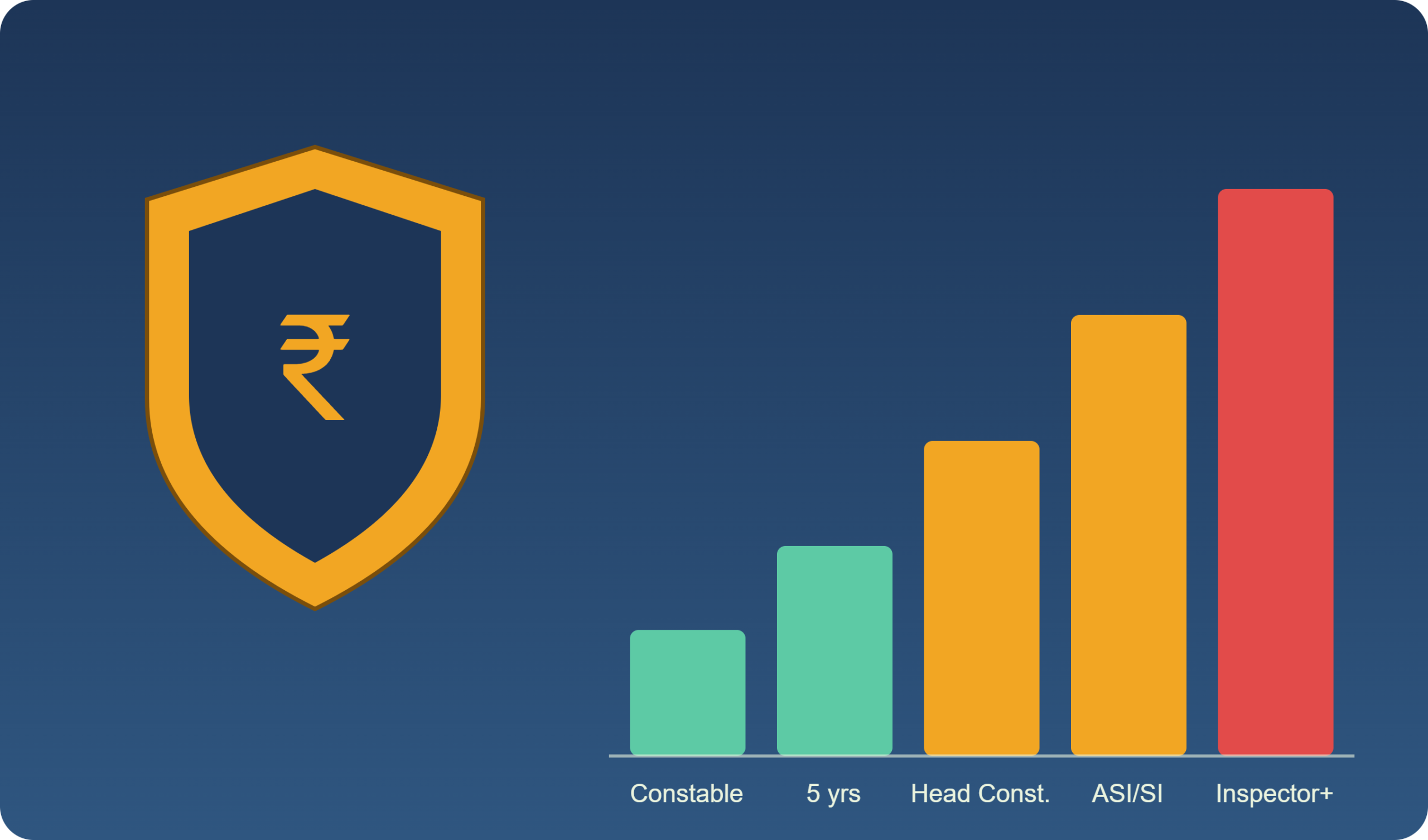
SRPF Salary After 5 and 10 Years of Service
One of the most common questions among aspirants is how the salary grows over time. SRPF, like most Maharashtra government positions, offers an annual increment along with periodic DA revisions.
Salary Progression Timeline
| Years of Service | Approximate In-Hand Salary | Notes |
|---|---|---|
| At Joining | ₹30,000 – ₹40,000 | Starting basic pay with initial allowances |
| After 5 Years | ₹45,000 – ₹50,000 | Annual 3% basic pay increment plus DA hikes |
| After 10 Years | ₹60,000+ | Often accompanied by promotion to Head Constable |
| After 15–20 Years | ₹70,000 – ₹90,000+ | Possible promotion to ASI/SI depending on performance and vacancies |
A constable typically receives an annual increment of around 3% on their basic pay, in line with standard government pay commission rules. Combined with periodic DA revisions (which are adjusted to offset inflation), the effective salary growth is often higher than the increment percentage alone would suggest.
Allowances Available to SRPF Personnel
Beyond the basic pay and DA, SRPF personnel are entitled to a range of allowances designed to compensate for the demanding and often unpredictable nature of the job.
Major Allowances
| Allowance Type | Purpose |
|---|---|
| Dearness Allowance (DA) | Offsets inflation; revised periodically by the state government |
| House Rent Allowance (HRA) | Covers housing costs, varies by city classification |
| Travel Allowance (TA) | Compensates for commuting and field travel |
| Ration/Kit Allowance | Covers food and uniform-kit related expenses during deployment |
| Medical Allowance | Basic healthcare and medical reimbursement support |
| Risk/Hardship Allowance | Paid for postings in high-risk or remote/insurgency-affected areas |
| Special Duty Allowance | Applicable during election duty, VIP security, or riot-control operations |
Special Police Allowances
SRPF personnel deployed on high-risk assignments — such as anti-Naxal operations, border area postings, or bandobast during major public events — often receive additional special duty pay on top of their regular salary. This is one of the key differentiators between SRPF compensation and that of a regular desk-based government employee.
Deductions From SRPF Salary
Like any government job, the gross salary is not the amount that lands in the bank account. Several standard deductions apply.
| Deduction Type | Purpose |
|---|---|
| National Pension System (NPS) | Mandatory retirement savings contribution |
| Group Insurance Scheme | Provides life and accident insurance coverage |
| Professional Tax | State-level tax applicable to salaried employees |
| Welfare Fund Contribution | Supports internal welfare schemes for police personnel and families |
After these deductions, the gross salary of ₹38,000–₹48,000 for a constable typically comes down to an in-hand figure of ₹30,000–₹45,000, depending on the specific deployment and applicable allowances.
SRPF vs Maharashtra Police Constable: Salary Comparison
Aspirants often want to know how SRPF compensation compares to a regular Maharashtra Police Constable role, since both fall under similar pay bands.
| Force | Basic Pay | In-Hand Salary | Nature of Work |
|---|---|---|---|
| SRPF Constable | ₹21,700 | ₹30,000 – ₹40,000 | High-risk, mobile deployment, riot control, VIP security |
| Maharashtra Police Constable | ₹21,700 | ₹30,000 – ₹40,000 | Civil policing, local law enforcement, station duties |
While the base pay scales are largely similar, SRPF personnel are more likely to receive additional risk and special duty allowances due to the nature of their postings, which can push their effective take-home pay slightly higher in certain circumstances. However, this also comes with a trade-off: SRPF postings often involve longer periods away from home and more physically demanding assignments compared to a fixed local police station posting.
Non-Monetary Benefits and Facilities
Salary is only one part of the overall compensation package. SRPF personnel also receive a range of benefits that add significant long-term value beyond the monthly paycheck.
Major Benefits
- Government Housing/Barrack Accommodation: Many SRPF postings include free or subsidized accommodation within the battalion premises.
- Pension and Retirement Benefits: Coverage under the National Pension System (NPS), along with gratuity benefits upon retirement.
- Medical Facilities: Access to government hospitals and dispensaries for the employee and, in many cases, their dependents.
- Job Security: As a state government position, SRPF offers strong job stability compared to private-sector security roles.
- Promotional Avenues: Clear departmental promotion channels from Constable up to senior officer ranks based on seniority, performance, and departmental exams.
- Paid Leave: Annual leave, casual leave, and medical leave entitlements as per state government service rules.
- Uniform and Kit Allowance: Provision or reimbursement for uniforms, boots, and other required gear.
Eligibility Criteria for SRPF Recruitment
For those considering applying, it helps to understand the basic eligibility requirements alongside the salary expectations.
| Criteria | Requirement (Typical, Constable Level) |
|---|---|
| Educational Qualification | 12th pass (Higher Secondary) from a recognized board |
| Age Limit | Generally 18 to 28 years (relaxations apply for reserved categories) |
| Physical Standards | Minimum height, chest measurement, and fitness test requirements as per Maharashtra Police norms |
| Nationality | Indian citizen with domicile requirements as specified in the recruitment notification |
| Physical Efficiency Test | Running, long jump, and other fitness benchmarks must be cleared |
Exact eligibility criteria can vary slightly between recruitment cycles, so aspirants should always check the latest official notification from the Maharashtra Police recruitment board before applying.
SRPF Recruitment Process
Understanding how the recruitment process works can help aspirants prepare more effectively for a role that ultimately leads to the salary structure discussed above.
Typical Recruitment Stages
- Online Application: Candidates apply through the official Maharashtra Police recruitment portal during the notified application window.
- Physical Measurement Test (PMT): Height, chest, and other physical measurements are verified against minimum standards.
- Physical Efficiency Test (PET): Includes running, and in some cases long jump or other fitness benchmarks.
- Written Examination: Tests general knowledge, reasoning, arithmetic, and current affairs.
- Document Verification: Educational certificates, domicile, category certificates, and other documents are verified.
- Medical Examination: A thorough medical fitness check is conducted before final selection.
- Training Period: Selected candidates undergo training before being confirmed and posted to a battalion.
Career Growth and Promotion Path in SRPF
One of the most attractive aspects of an SRPF career, beyond the starting salary, is the long-term promotional pathway available to dedicated personnel.
Typical Promotion Hierarchy
- Constable
- Head Constable
- Assistant Sub-Inspector (ASI)
- Sub-Inspector (SI)
- Inspector
- Assistant Commissioner of Police (ACP)
- Deputy Commissioner of Police (DCP)
Promotions are generally based on a combination of seniority, departmental examinations, performance record, and vacancy availability. Personnel who perform well and clear the required departmental exams can see substantial jumps in both rank and salary over a 15–20 year career span.
Factors That Influence SRPF Salary Variation
While the tables above provide a solid approximation, several factors can cause actual salary figures to vary from one individual to another.
- Posting Location: Urban postings typically carry higher HRA than rural or battalion-based postings.
- Nature of Deployment: Personnel assigned to high-risk zones or special operations may receive additional hazard pay.
- DA Revisions: Dearness Allowance is revised periodically by the state government based on inflation trends, which directly affects gross salary.
- Pay Commission Updates: Any future revision to the state pay commission structure would proportionally affect the entire pay scale.
- Category-Based Reservations: While this doesn’t affect the salary itself, it can affect the pace of promotion for personnel recruited under specific reservation categories, indirectly influencing long-term earnings.
Frequently Asked Questions About SRPF Salary
1. What is the starting salary of an SRPF Constable? The starting basic pay is ₹21,700 per month, with an in-hand salary typically ranging between ₹30,000 and ₹40,000 after allowances and deductions.
2. Is SRPF a government job? Yes, SRPF is a state government job operating under the Maharashtra Home Department and Maharashtra Police.
3. Does SRPF salary increase every year? Yes, personnel typically receive an annual increment of approximately 3% on their basic pay, along with periodic Dearness Allowance revisions.
4. How much does an SRPF Head Constable earn? A Head Constable’s pay scale ranges from approximately ₹25,500 to ₹81,100, with a total in-hand salary (including allowances) generally between ₹35,000 and ₹45,000.
5. Is the SRPF salary higher than a regular Maharashtra Police Constable’s salary? The base pay scales are largely similar, though SRPF personnel may earn somewhat more in specific circumstances due to additional risk and special duty allowances tied to their deployment.
6. What allowances are included in the SRPF salary? Key allowances include Dearness Allowance, House Rent Allowance, Travel Allowance, Ration/Kit Allowance, Medical Allowance, and, where applicable, Risk or Special Duty Allowance.
7. What is the salary during the SRPF training period? During training, recruits receive the basic pay of ₹21,700 along with applicable DA, but full field allowances like HRA and risk pay are usually only activated after official posting.
8. What is the maximum salary an SRPF Constable can reach? Within the constable pay scale itself, basic pay can rise up to approximately ₹69,100 over the course of a career, before accounting for promotions to higher ranks.
Conclusion
SRPF offers a stable, government-backed career path with a competitive salary structure that grows steadily through annual increments, periodic DA revisions, and a clear promotional hierarchy. While the starting in-hand salary for a Constable typically falls between ₹30,000 and ₹40,000 per month, this figure can grow significantly over a career — reaching ₹60,000 or more within a decade, and considerably higher for those who rise through the ranks to Sub-Inspector, Inspector, or beyond.
Beyond the numbers, SRPF also provides job security, pension benefits, medical facilities, and accommodation support — factors that make the overall compensation package more attractive than the basic pay figure alone suggests. For aspirants weighing an SRPF career against other state government or police roles, understanding this complete picture — basic pay, allowances, deductions, and long-term growth — is essential to making an informed decision.
Note: Salary figures mentioned in this article are approximate and based on publicly available pay scale information. Actual salary may vary based on posting location, specific allowances applicable, DA revisions, and updates to government pay structures. Candidates are advised to refer to official Maharashtra Police recruitment notifications for the most current and precise figures.
