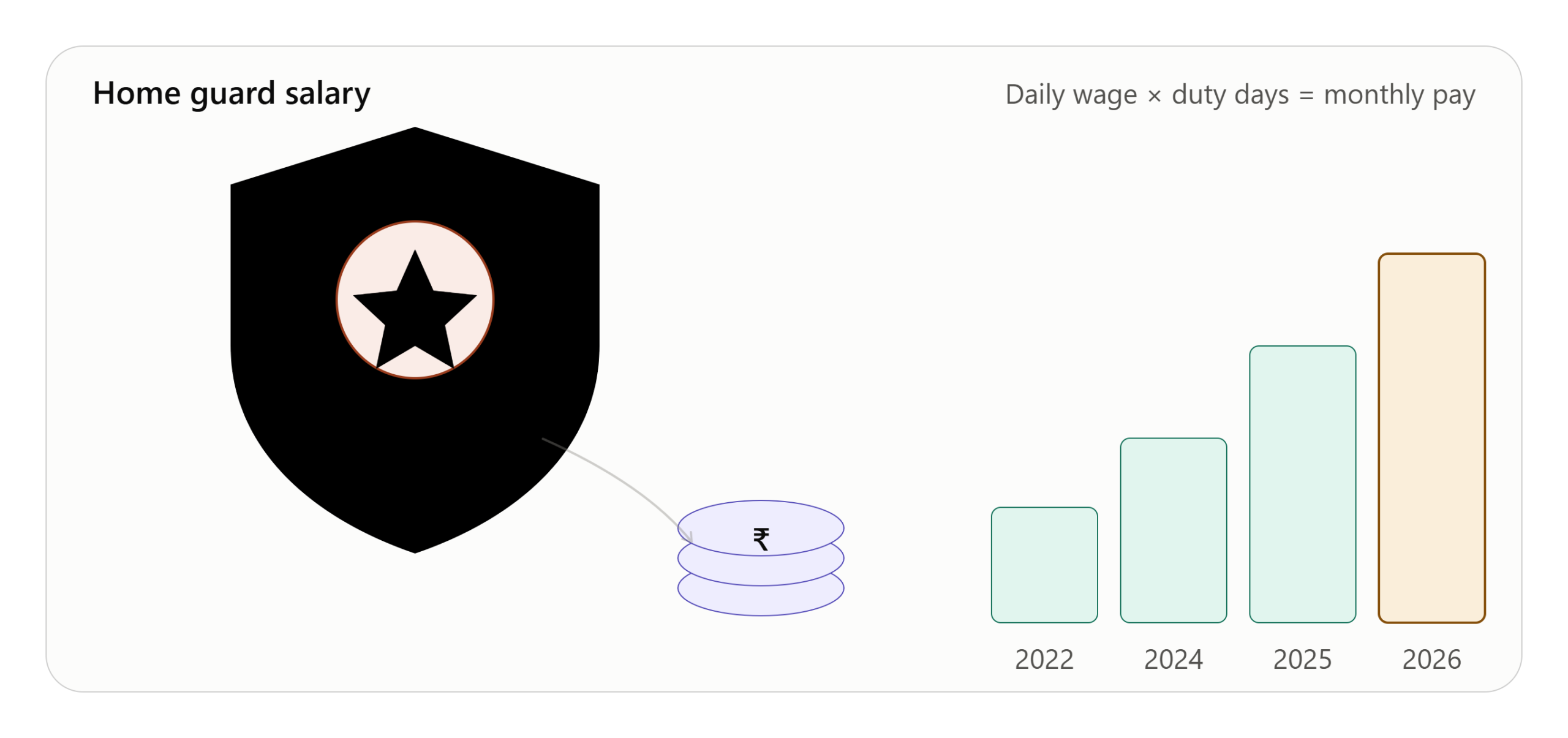
The Home Guard is one of India’s most recognized voluntary uniformed forces, working alongside the police to maintain law and order, assist during natural disasters, manage traffic, and support security at public events. Because it is a part-time, duty-based role rather than a permanent government job, the “Home Guard salary” is actually a daily wage that varies from state to state and depends heavily on the number of duty days assigned each month.
This guide breaks down everything a candidate or curious reader needs to know about Home Guard pay in 2026 — the national averages, state-by-state daily wages, in-hand monthly income, allowances, deductions, career growth, and answers to the most commonly asked questions.
Table of Contents
What Is the Home Guard Force?
The Home Guard is a voluntary force raised under the Home Guards Act, first conceived to support the police and civil defence machinery during emergencies. Over the decades, its role has expanded well beyond emergency response. Today, Home Guards are deployed for:
- Traffic regulation and management in cities and towns
- Assistance during festivals, elections, and large public gatherings
- Disaster relief operations such as floods, fires, and accidents
- Security duties at government offices, banks, and public institutions
- Support to local police stations during high-demand periods
Unlike police constables, Home Guards are not part of the permanent police cadre. They are engaged on a duty basis, which is why their compensation is structured as a daily wage rather than a fixed monthly salary.
Home Guard Salary Overview 2026
Across India, Home Guard pay is calculated using a simple formula:
Monthly Income = Daily Wage Rate × Number of Duty Days
This is why two Home Guards in the same state can end up with very different monthly earnings — one might get 30 duty days in a month while another gets only 15–20.
| Particular | Details |
|---|---|
| Nature of Job | Voluntary, duty-based (not permanent) |
| Salary Type | Daily wage / duty allowance |
| National Monthly Range (2026) | ₹10,000 – ₹32,000 approx. |
| National Daily Wage Range | ₹300 – ₹1,100+ |
| Highest Paying State (approx.) | Jharkhand (~₹1,088/day) |
| Lowest Paying State (approx.) | West Bengal (~₹300–₹500/day) |
| Pension Applicable | No |
| Provident Fund / ESI | Sometimes, depending on state policy |
| Governing Body | State Home Guard & Civil Defence Department |
Because pay structures are set independently by each state government, there is no single “official” Home Guard salary for the whole country. Instead, it is best understood as a range shaped by regional policy, cost of living, and periodic wage revisions.
Home Guard Salary Growth Over the Years (2010–2026)
Home Guard wages have risen gradually over the years as states have revised daily allowance rates in line with inflation and Dearness Allowance (DA) adjustments. Below is an approximate trend showing how national average pay has moved over time.
| Year | Daily Salary (Approx.) | Monthly Salary (Approx.) | Notes |
|---|---|---|---|
| 2010–2015 | ₹150 – ₹300 | ₹4,500 – ₹9,000 | Minimal wage structure |
| 2016–2020 | ₹300 – ₹500 | ₹9,000 – ₹15,000 | Gradual state-level revisions |
| 2021 | ₹500 – ₹700 | ₹15,000 – ₹22,000 | Post-pandemic pay adjustments |
| 2022 | ₹550 – ₹750 | ₹16,000 – ₹24,000 | Regular revisions begin |
| 2023 | ₹600 – ₹800 | ₹18,000 – ₹25,000 | Common national average established |
| 2024 | ₹650 – ₹1,000 | ₹20,000 – ₹30,000 | Major hikes in several key states |
| 2025 | ₹750 – ₹1,100 | ₹22,000 – ₹33,000 | Strong growth phase |
| 2026 | ₹600 – ₹1,100+ | ₹20,000 – ₹30,000+ | Varies by state and duty days |
The upward trend reflects growing recognition of the Home Guard force’s contribution to public safety, along with sustained demand for their deployment during elections, festivals, and emergency situations.
State-Wise Home Guard Salary in India (2026)
Salary structures differ significantly across states. Below is a state-wise comparison of daily wages and approximate monthly income.
| State | Daily Salary (Approx.) | Monthly Salary (Approx.) |
|---|---|---|
| Jharkhand | ₹1,088 | ₹28,000 – ₹32,640 |
| Bihar | ₹700 – ₹1,120 | ₹21,000 – ₹33,630 |
| Maharashtra | ₹650 – ₹1,080 | ₹19,500 – ₹32,490 |
| Delhi | ₹700 – ₹1,000 | ₹25,000 – ₹30,000 |
| Telangana | ₹1,000 | ₹25,000 – ₹30,000 |
| Himachal Pradesh | ₹977 | ₹24,000 – ₹29,000 |
| Chhattisgarh | ₹774 | ₹23,010 – ₹33,201 |
| Karnataka | ₹500 – ₹800 | ₹15,000 – ₹24,000 |
| Uttar Pradesh | ₹500 – ₹675 | ₹12,000 – ₹20,200 (gross ~₹30,000) |
| Haryana | ₹600 – ₹750 | ₹19,900 – ₹22,700 |
| Gujarat | ₹400 – ₹650 | ₹12,000 – ₹18,000 |
| Rajasthan | ₹550 – ₹650 | ₹15,000 – ₹18,000 |
| Madhya Pradesh | ₹400 – ₹550 | ₹12,000 – ₹16,000 |
| Tamil Nadu | ₹450 – ₹650 | ₹14,000 – ₹18,000 |
| Odisha | ₹623 | ₹18,360 – ₹18,690 |
| West Bengal | ₹300 – ₹600 | ₹9,000 – ₹15,000 |
Note: Figures are approximate and can vary based on district, urban/rural posting, duty type, and periodic government revisions. Candidates should always verify current rates through their respective state Home Guard department notifications.
Jharkhand: The Highest-Paying State
Jharkhand currently offers one of the highest Home Guard daily wages in the country at approximately ₹1,088 per day, following a court-directed wage revision. For a full month of 30 duty days, this works out to a gross monthly salary of around ₹32,640, with an in-hand figure of roughly ₹32,390 after minor deductions.
Uttar Pradesh: A Structured Pay Scale
Uttar Pradesh stands out because its Home Guard pay is linked to the 7th Pay Commission, placing it under Pay Level 3 with a Grade Pay of ₹2,000. This gives UP Home Guards a more structured and predictable pay band compared to states that rely purely on daily wage calculations.
| Component | Details |
|---|---|
| Pay Commission | 7th Pay Commission |
| Pay Level | Level 3 |
| Grade Pay | ₹2,000 |
| Basic Pay (Monthly) | ₹5,200 – ₹20,200 |
| Annual Salary Range | ₹62,400 – ₹2,42,400 |
| Gross Salary (Approx.) | ₹30,000/month |
| In-Hand Salary (Approx.) | ₹27,000/month |
Bihar: Competitive Daily Wages
Bihar offers a daily wage of approximately ₹700–₹1,120, translating to a monthly in-hand salary in the range of ₹21,000 to ₹33,630, depending on duty days and district-level variations.
Delhi and Telangana: Strong Urban Pay Rates
Both Delhi and Telangana offer daily wages between ₹700 and ₹1,000, resulting in monthly earnings of roughly ₹25,000 to ₹30,000 — among the more attractive rates for urban postings.
Home Guard In-Hand Salary: What You Actually Take Home
The “in-hand” salary is what actually gets credited to a Home Guard’s bank account after standard deductions such as Provident Fund (where applicable), Employee State Insurance (ESI), and minor administrative deductions. Gross salary and in-hand salary can differ by a few thousand rupees depending on the state’s deduction policy.
| Salary Component | Approximate Monthly Amount |
|---|---|
| Gross Salary (Duty Wage Total) | ₹18,000 – ₹32,000 |
| Provident Fund Deduction (if applicable) | ₹200 – ₹800 |
| ESI Deduction (if applicable) | ₹100 – ₹300 |
| Other Administrative Deductions | ₹100 – ₹500 |
| Net In-Hand Salary | ₹17,000 – ₹31,000 |
Some states do not apply PF or ESI deductions at all for Home Guards, especially where the engagement is treated as a purely voluntary, honorarium-based role. This is one reason the gap between gross and in-hand pay can vary so widely across states.
Allowances and Benefits for Home Guards
While the daily wage forms the core of a Home Guard’s income, several states also provide additional allowances depending on duty type and posting conditions. Common allowances include:
- Dearness Allowance (DA): Periodic adjustment to offset inflation, applicable in states with structured pay scales like UP.
- House Rent Allowance (HRA): Provided in some states based on posting location (urban vs. rural).
- Transport Allowance (TA): Covers commuting costs for duty assignments.
- Medical Allowance: Basic medical benefits or reimbursement in select states.
- Night Duty / Shift Allowance: Extra pay for night shifts or extended duty hours.
- Uniform Maintenance Allowance: A small stipend for the upkeep of the uniform.
- Risk or Hazard Allowance: Applicable during disaster relief or high-risk deployments.
| Allowance Type | Typical Applicability |
|---|---|
| Dearness Allowance | States with structured pay scales (e.g., UP) |
| House Rent Allowance | Select states, varies by posting city |
| Transport Allowance | Most states, duty-based |
| Medical Allowance | Some states |
| Night Shift Allowance | Applicable during night postings |
| Uniform Maintenance | Most states |
| Risk/Disaster Allowance | During flood, fire, or emergency deployment |
Not all states offer every allowance listed above, and the exact amounts differ. Home Guards should check their specific state’s Home Guard department circulars for the most accurate and current allowance structure.
Home Guard Salary by Experience and Regularization
Unlike many government jobs, the Home Guard role does not have a formal seniority-based pay scale in most states. However, there are two notable pathways that can affect long-term earnings:
- Continued Service with Duty Priority: Home Guards with longer service records are often prioritized for more duty days, which directly increases monthly income even without a formal pay hike.
- Regularization into Constable Posts: In rare cases, some states offer regularization opportunities where experienced Home Guards can be absorbed into constable-level positions in the police department. This shift significantly increases pay, benefits, and job security.
| Career Stage | Approximate Monthly Income |
|---|---|
| New Home Guard (Entry Level) | ₹10,000 – ₹18,000 |
| Experienced Home Guard (Priority Duty Days) | ₹20,000 – ₹32,000 |
| Regularized as Police Constable (Rare) | ₹27,000 – ₹33,000+ (with full benefits) |
It’s worth noting that regularization is not guaranteed and depends entirely on state government policy, vacancy availability, and specific recruitment drives.
Comparison: Home Guard vs Police Constable Salary
A frequent point of confusion is how Home Guard pay compares to that of a regular police constable. The table below highlights the key differences.
| Aspect | Home Guard | Police Constable |
|---|---|---|
| Job Type | Voluntary, duty-based | Permanent government employee |
| Salary Structure | Daily wage | Fixed monthly pay scale |
| Monthly Pay (Approx.) | ₹10,000 – ₹32,000 | ₹25,000 – ₹45,000+ |
| Pension | Not available | Available (under applicable scheme) |
| Job Security | Limited, duty-dependent | High |
| Promotion Scope | Very limited | Structured promotion ladder |
| Working Hours | Assignment-based | Fixed shifts with defined duty roster |
This comparison makes it clear that while Home Guard work offers flexibility and a relatively quick entry point into uniformed service, it does not carry the same long-term financial security as a permanent constable position.
Factors That Affect Home Guard Salary
Several variables influence how much a Home Guard actually earns in a given month:
- Number of Duty Days: The single biggest factor. More assigned duty days directly translate to higher monthly income.
- State of Posting: Daily wage rates are set independently by each state, leading to significant regional variation.
- Type of Duty: Election duty, festival security, and disaster relief sometimes attract higher daily rates or additional allowances.
- Urban vs Rural Posting: Urban postings may include HRA or higher allowances compared to rural assignments.
- Government Wage Revisions: Periodic DA hikes and policy revisions can raise the base daily wage over time.
- Attendance and Discipline: Consistent attendance often improves the chances of being prioritized for more duty days.
How to Calculate Your Expected Home Guard Salary
Using the standard formula, here is a simple illustration of how monthly income is calculated:
Example: If a Home Guard in Odisha earns a daily wage of ₹623 and is assigned 30 duty days in a month:
₹623 × 30 = ₹18,690 (approximate monthly gross salary)
| Duty Days in a Month | Daily Wage ₹600 | Daily Wage ₹800 | Daily Wage ₹1,000 |
|---|---|---|---|
| 15 days | ₹9,000 | ₹12,000 | ₹15,000 |
| 20 days | ₹12,000 | ₹16,000 | ₹20,000 |
| 25 days | ₹15,000 | ₹20,000 | ₹25,000 |
| 30 days | ₹18,000 | ₹24,000 | ₹30,000 |
This table illustrates why duty allocation matters just as much as the daily wage rate itself when estimating actual take-home pay.
Eligibility Criteria for Home Guard Recruitment
While specific requirements vary by state, general eligibility criteria typically include:
- Age Limit: Usually between 18 and 45 years, though this varies by state and category (relaxations often apply for reserved categories and ex-servicemen).
- Educational Qualification: Typically a minimum of 10th or 12th pass, depending on the state and post.
- Physical Standards: Minimum height, chest measurement, and physical fitness criteria similar to other uniformed services.
- Domicile Requirement: Most states require candidates to be residents of that state or a specific district.
- Medical Fitness: Candidates must clear a basic medical examination.
| Eligibility Parameter | Typical Requirement |
|---|---|
| Minimum Age | 18 years |
| Maximum Age | 45 years (varies by state) |
| Education | 10th/12th pass (varies by post) |
| Height (Male) | 165–170 cm (approx., state-dependent) |
| Height (Female) | 150–157 cm (approx., state-dependent) |
| Domicile | State/district resident (usually mandatory) |
Job Profile and Daily Responsibilities
A Home Guard’s day-to-day responsibilities can vary widely depending on the assignment, but generally include:
- Assisting local police in maintaining law and order during routine and special duty
- Managing traffic at busy intersections, during festivals, or VIP movements
- Providing security cover at polling booths during elections
- Supporting fire and disaster management teams during emergencies
- Guarding public property, government buildings, and banks
- Assisting during large public events such as religious gatherings, fairs, and sporting events
This wide-ranging role is one reason Home Guards are considered a valuable extension of the state police and civil defence machinery.
Pros and Cons of Joining as a Home Guard
Advantages:
- Relatively easier and quicker recruitment process compared to permanent police posts
- Opportunity to serve in a uniformed capacity and gain experience relevant to future police or security jobs
- Flexible duty assignments in many states
- Potential pathway to regularization in select cases
Limitations:
- No fixed monthly salary — income depends on duty days
- No pension or long-term retirement benefits
- Limited promotion and career growth compared to permanent police cadre
- Job security is tied to continued state government policy and budget allocation
Frequently Asked Questions (FAQs)
Q1. What is the average salary of a Home Guard in India in 2026? The average Home Guard salary in India ranges from approximately ₹10,000 to ₹32,000 per month, depending on the state and number of duty days assigned.
Q2. Which state pays the highest Home Guard salary? Jharkhand currently offers one of the highest daily wages at approximately ₹1,088 per day, following a court-mandated revision, translating to a monthly salary of around ₹32,000.
Q3. Is Home Guard a permanent government job? No. Home Guard is a voluntary, duty-based engagement and is not classified as a permanent government job. It does not come with pension benefits.
Q4. Do Home Guards get a pension? No, pension benefits are generally not available to Home Guards since the role is voluntary and duty-dependent, not a permanent cadre position.
Q5. What is the in-hand salary of a UP Home Guard? The in-hand salary for a UP Home Guard is approximately ₹27,000 per month, with a gross salary of around ₹30,000, under Pay Level 3 of the 7th Pay Commission.
Q6. How is Home Guard salary calculated? Home Guard salary is calculated by multiplying the daily wage rate by the number of duty days assigned in a month (Daily Wage × Duty Days = Monthly Income).
Q7. Can a Home Guard become a police constable? In some states, experienced Home Guards may be considered for regularization into constable posts, though this depends on specific state policies and is not guaranteed.
Q8. What allowances do Home Guards receive? Depending on the state, Home Guards may receive Dearness Allowance, House Rent Allowance, Transport Allowance, Medical Allowance, Night Duty Allowance, and Uniform Maintenance Allowance.
Conclusion
The Home Guard salary structure in India for 2026 reflects a wide range — from around ₹10,000 to over ₹32,000 per month — shaped primarily by the state of posting and the number of duty days assigned. States like Jharkhand, Bihar, Delhi, and Telangana currently offer some of the more attractive daily wages, while states like West Bengal remain on the lower end of the pay spectrum. Uttar Pradesh stands out for its more structured pay scale linked to the 7th Pay Commission.
While the role does not offer the same job security, pension, or fixed salary structure as a permanent police constable position, it remains a meaningful entry point into uniformed public service — offering flexible engagement, relevant experience, and in select cases, a pathway to regularization. Anyone considering this role should check the latest notifications from their respective state Home Guard and Civil Defence department, since daily wage rates and allowances are revised periodically and can change without extensive public notice.
