Introduction: What Does MYF Mean
If you’ve ever received a text, DM, or comment that simply said “myf” and felt completely lost, you’re far from alone. This tiny three-letter acronym has become increasingly common across social media and messaging apps, yet it carries several completely different meanings depending on who sends it and in what context. This guide breaks down everything you need to know about MYF — its various meanings, how to use it correctly, and how to avoid awkward misunderstandings.
Table of Contents
Quick Summary
Before diving into the details, here’s the short version for anyone in a hurry.
| Aspect | Details |
|---|---|
| Most common meaning | “Miss Your Face” — an affectionate phrase |
| Other common meanings | “Mind Your Business” (blunt/defensive) and “My Fault” (casual apology) |
| Tone | Depends entirely on context and emojis used |
| Best used with | Close friends, partners, or casual acquaintances |
| Risk level | Can be misread as rude if sent without context |
| Common platforms | Instagram, Snapchat, TikTok, WhatsApp, X (Twitter) |
Understanding the Basics of MYF
What Does MYF Stand For?
MYF is one of those internet acronyms that doesn’t have a single locked-in definition. Instead, it functions more like a flexible shorthand that different groups of people have adapted to mean different things. This is fairly common with three-letter texting abbreviations — think of how “TTYL” always means “talk to you later,” but shorter or less established acronyms like MYF tend to splinter into multiple interpretations as different online communities adopt them.
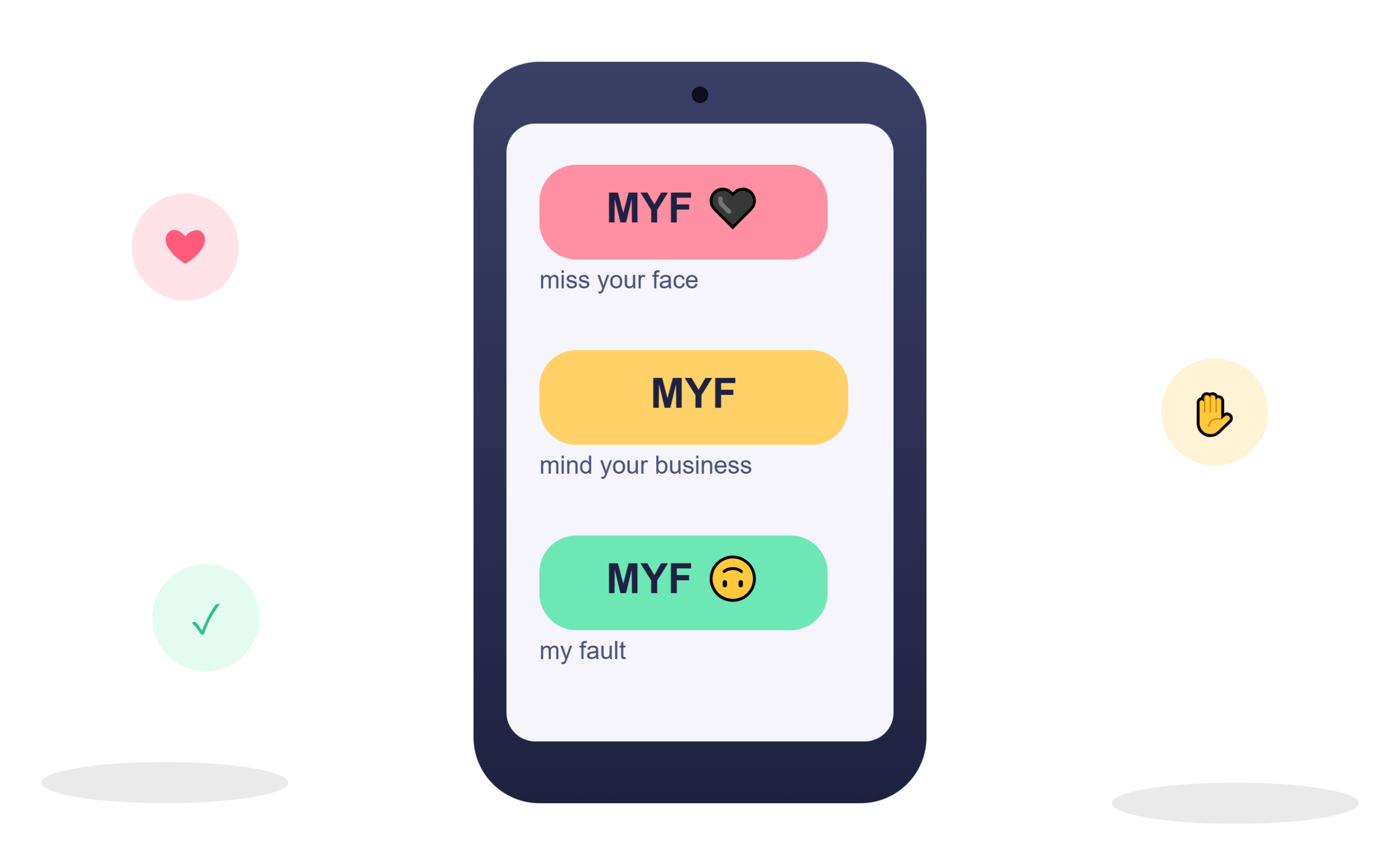
The three most widely recognized expansions are:
- Miss Your Face — a warm, affectionate way of telling someone you miss them, often used between close friends, partners, or family members.
- Mind Your Business — a sharper, more defensive phrase used to shut down a nosy question or unwanted opinion.
- My Fault — a quick, informal way of taking responsibility for a small mistake, similar to saying “my bad.”
A less common but still occasionally seen variant is Miss You Friend, typically used in group chats as a slightly more platonic version of “miss your face.”
Why Does One Acronym Have So Many Meanings?
Texting slang evolves organically. Unlike dictionary words that go through some kind of formal vetting process, internet abbreviations are created independently by different communities who often have no awareness of how the same letters are being used elsewhere. Over time, as these phrases spread across different platforms and demographics, multiple meanings can end up attached to the exact same acronym.
This is part of a broader pattern in digital communication where brevity is prioritized over precision — younger users especially tend to favor compressed language in texting and captions, letting tone, emojis, and context carry the actual meaning rather than the words themselves.
Breaking Down Each Meaning of MYF
MYF as “Miss Your Face”
This is generally considered the most common and widely recognized meaning of MYF, particularly in the context of close friendships and romantic relationships. It’s a slightly more personal and affectionate variation of the classic “I miss you,” with “face” adding a warmer, more specific touch — as though you’re picturing the person rather than just thinking about them abstractly.
| Element | Detail |
|---|---|
| Tone | Warm, affectionate, sometimes flirty |
| Typical senders | Close friends, partners, family |
| Common pairing | Heart emojis, crying-face emojis, throwback photos |
| Example use | “Saw your old photos and just, myf 🥹” |
MYF as “Mind Your Business”
On the opposite end of the emotional spectrum, MYF can also be a clipped, somewhat blunt way of telling someone to stop prying into your personal life. In this context, it functions similarly to the more widely known acronym MYOB (Mind Your Own Business). Some users insert an implied expletive before “business,” making the phrase read as more aggressive — though among friends, it’s usually delivered more like a joking deflection than a genuine insult.
| Element | Detail |
|---|---|
| Tone | Defensive, blunt, occasionally sarcastic |
| Typical senders | Anyone avoiding a nosy question |
| Common pairing | No emoji, or a single dismissive emoji like 🙄 |
| Example use | “Why did you two break up?” — “myf” |
MYF as “My Fault”
The third major interpretation is much more low-stakes. Here, MYF is simply a fast way to acknowledge a small mistake — sending a message to the wrong chat, showing up a few minutes late, or forgetting to reply. It’s functionally interchangeable with “my bad” or “mb.”
| Element | Detail |
|---|---|
| Tone | Casual, apologetic |
| Typical senders | Anyone owning up to a minor slip-up |
| Common pairing | 😅 or 🙃 emojis |
| Example use | “Sent that to the wrong group chat, myf” |
How Context Determines the Real Meaning
Since MYF doesn’t come with a built-in label telling you which version is being used, the surrounding conversation is really the only reliable way to figure out what someone means. A few signals to watch for:
- What came before it. If the previous message involved a personal or nosy question, MYF is probably “mind your business.” If it followed a nostalgic photo or a long gap in conversation, it’s more likely “miss your face.”
- Emoji usage. Heart emojis, crying-laughing faces, or sentimental captions point toward the affectionate meaning. A flat, emoji-free “myf” is more often the defensive version.
- Relationship with the sender. Between partners or close friends catching up after time apart, “miss your face” is the safer bet. In reply to unsolicited advice or gossip, assume the blunt meaning.
- Platform. As covered in more detail below, certain platforms lean toward one meaning more than others.
MYF Across Different Situations and Examples
The table below illustrates how the same acronym can carry drastically different emotional weight depending on the scenario.
| Situation | Example Message | Likely Meaning | Emotional Tone |
|---|---|---|---|
| Reconnecting after a long time | “It’s been way too long, myf so bad” | Miss Your Face | Nostalgic |
| Ending a phone call | “Okay bye, myf already” | Miss Your Face | Warm/playful |
| Dodging a personal question | “So what actually happened between you two?” — “myf” | Mind Your Business | Defensive |
| Receiving unsolicited advice | “You should really change your major” — “myf tbh” | Mind Your Business | Annoyed |
| Texting the wrong group chat | “Oops, ignore that last message, myf” | My Fault | Apologetic |
| Bumping into someone accidentally | “Oop myf, wasn’t looking” | My Fault | Casual apology |
| Commenting on an old photo | “This picture omg myf” | Miss Your Face | Sentimental |
| Shutting down gossip | “Not getting into it, myf” | Mind Your Business | Firm/closed-off |
| Teasing a curious friend | “Ok nosy, myf 😂” | Mind Your Business | Lighthearted |
| Reacting to a throwback video | “myf every time I see this” | Miss Your Face | Sentimental |
MYF on Different Social Media Platforms
While the core meanings of MYF stay consistent no matter where you see it, the likelihood of one meaning over another can shift depending on the platform’s culture and typical use case.
MYF on Instagram
Instagram tends to be a mixed bag. In captions under old or nostalgic photos, MYF almost always means “miss your face.” However, in comment sections — especially under posts where someone is offering an opinion nobody asked for — MYF is more likely being used as a dismissive “mind your business.”
MYF on Snapchat
Snapchat’s culture revolves heavily around selfies, streaks, and quick personal updates, which pushes MYF strongly toward the “miss your face” interpretation. It’s a natural caption for a “memories” resurfacing feature or a nostalgic throwback Snap.
MYF on TikTok
TikTok comment sections are where MYF shows the widest range of tone. Under nostalgic duets, “remember when” edits, or sentimental friend-group content, it usually reads as affectionate. But in back-and-forth comment arguments, it can appear as a sharp, dismissive “mind your business.”
MYF on WhatsApp
Because WhatsApp conversations are typically more private and personal, MYF here leans heavily toward the warm, affectionate meaning — often accompanied by a voice note or a photo.
MYF on X (formerly Twitter)
On more public platforms like X, MYF shows up less often, but when it does, it’s more frequently used in the “mind your business” sense, especially in reply threads where someone is pushing back against unsolicited commentary.
| Platform | Most Common Meaning | Typical Context |
|---|---|---|
| Mixed (captions vs. comments) | Captions = affectionate, comments = defensive | |
| Snapchat | Miss Your Face | Nostalgic Memories/throwback Snaps |
| TikTok | Mixed | Sentimental duets vs. comment arguments |
| Miss Your Face | Personal one-on-one chats | |
| X (Twitter) | Mind Your Business | Public reply threads |
Is MYF Considered Rude?
Whether MYF comes across as rude depends entirely on which meaning is being used and who it’s being sent to.
When it means “Miss Your Face”: This version is warm and affectionate, essentially the texting equivalent of a hug. It’s not rude in any context and is generally seen as a sweet, low-effort way to express fondness.
When it means “Mind Your Business”: This version is inherently more confrontational, since its entire purpose is to shut down a conversation. Between close friends, it’s typically read as playful deflection rather than a genuine insult. However, sent to someone you don’t know well, or in a more formal setting, it can easily come across as curt, dismissive, or even hostile.
When it means “My Fault”: This version is neutral to mildly self-deprecating and is essentially never considered rude.
The general rule of thumb: reserve MYF for casual conversations with people who already understand your communication style. Avoid it in professional messages, unfamiliar group chats, or with anyone who might not be familiar with internet slang.
How to Reply to MYF
Not sure how to respond when someone sends you a lone “myf”? Here’s a breakdown of appropriate responses depending on the likely meaning.
| Their Message | Suggested Reply | Tone of Reply |
|---|---|---|
| “myf 🥹” | “myf too, let’s catch up soon” | Warm |
| “myf” (after a personal question) | “Fair enough, didn’t mean to pry” | De-escalating |
| “myf, wasn’t looking where I was going” | “All good, no worries!” | Easygoing |
| “myf” (meaning unclear) | “Wait, which myf do you mean lol” | Clarifying |
| “myf tbh” | “Noted, I’ll drop it 😅” | Respectful |
| “myf so bad” | “Same, we really need to hang out” | Affectionate |
If you’re ever genuinely unsure which meaning someone intended, it’s completely fine to just ask. A quick “wait which myf” is a normal, low-stakes way to clear up any confusion without it feeling awkward.
Similar Acronyms and Texting Slang Worth Knowing
MYF exists alongside a broader ecosystem of texting shorthand. Knowing these related acronyms can help you navigate similar situations.
| Acronym | Meaning |
|---|---|
| MYOB | Mind Your Own Business |
| MYFB | Mind Your F-ing Business |
| MB | My Bad |
| MYT | Miss You Too |
| ILY | I Love You |
| NBD | No Big Deal |
| WYD | What You Doing |
| TBH | To Be Honest |
| IYKYK | If You Know You Know |
| NGL | Not Gonna Lie |
Frequently Asked Questions
What does MYF mean in a text from a friend? It usually carries the same range of meanings regardless of who sends it, though among close friends, “Miss Your Face” is the most common interpretation.
Is MYF the same thing as MYOB? Not exactly. MYOB almost always means “Mind Your Own Business,” while MYF is more flexible and can mean that, or something entirely different like “Miss Your Face,” depending on context.
Can MYF be used romantically? Yes. When used to mean “Miss Your Face,” it’s a common, casual way for partners or close friends to express affection, especially after time apart.
Is it okay to use MYF in a work or professional setting? Generally, no. Since the meaning is genuinely ambiguous and one interpretation can come across as dismissive, it’s best kept to casual, personal conversations.
What should I do if I’m not sure what someone means by MYF? The safest option is to simply ask for clarification, or look at the tone and context of the conversation leading up to it.
Does MYF mean the same thing on every app? Not necessarily. As covered above, more personal platforms like WhatsApp and Snapchat lean toward the affectionate meaning, while public comment sections and reply threads lean more toward the defensive meaning.
Final Thoughts
MYF is a great example of how modern texting slang thrives on ambiguity, letting context, tone, and platform culture fill in the gaps that the letters alone don’t explain. Whether someone is telling you they miss your face, asking you to back off, or simply owning up to a small mistake, the surrounding conversation will almost always tell you which one applies. The next time a bare “myf” lands in your inbox and leaves you scratching your head, run through the checklist above — who sent it, what came before it, and whether there’s an emoji attached — and you’ll have a pretty reliable read on what they actually mean.
