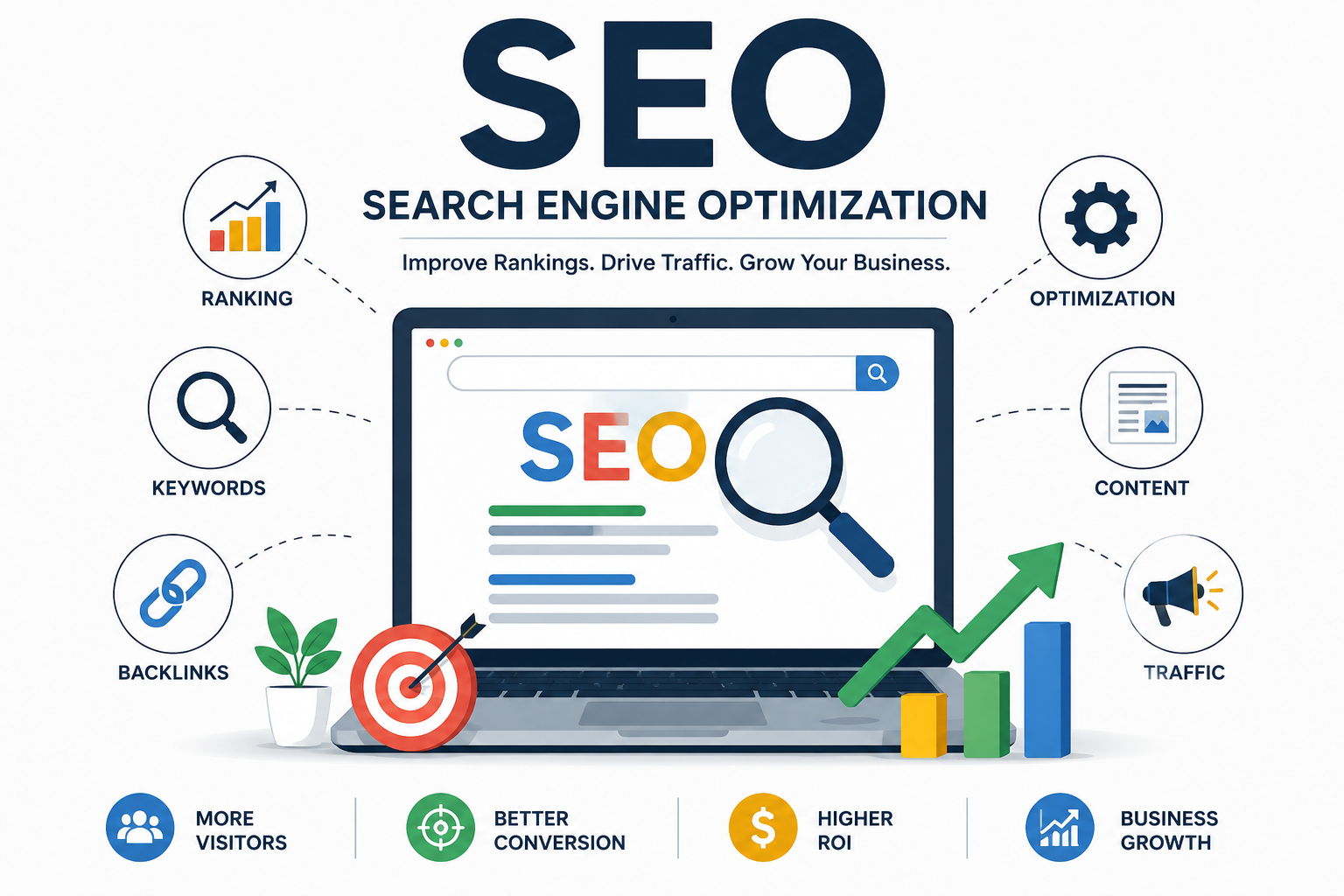
Search Engine Optimization (SEO) is the practice of improving a website so that it appears higher in the organic (unpaid) search results of platforms like Google, Bing, and increasingly, AI-powered answer engines. In simple terms, SEO is about making your website easier for search engines to find, understand, and trust — while also making it genuinely useful for the people who visit it.
Whether you’re a business owner, blogger, marketer, or developer, understanding SEO is one of the most valuable skills you can develop today. Unlike paid advertising, which stops generating traffic the moment you stop paying, SEO builds a long-term asset. A well-optimized page can continue driving free, targeted traffic for years.
In this guide, we’ll break down everything you need to know about Search Engine Optimization — from the fundamentals to advanced technical strategies — so you can build a website that ranks well and converts visitors into customers, readers, or subscribers.
Table of Contents
What Is Search Engine Optimization?
Search Engine Optimization refers to the collection of strategies, techniques, and best practices used to increase the visibility of a website or webpage in search engine results pages (SERPs). When someone types a query into Google, the search engine’s algorithm scans billions of pages to determine which ones are the most relevant, authoritative, and trustworthy for that specific search.
SEO exists because search engines cannot “understand” a webpage the way a human does. They rely on signals — text, code, links, user behavior, and hundreds of other factors — to determine what a page is about and whether it deserves to rank. The goal of SEO is to send the right signals so that search engines recognize your content as the best possible answer to a user’s query.
Why SEO Matters for Businesses and Creators
Search remains one of the primary ways people discover new websites, products, and information. Consider the following:
- Most online experiences begin with a search engine.
- Organic search typically drives more long-term traffic than paid ads once a site is established.
- Ranking on the first page dramatically increases click-through rates compared to later pages.
- SEO builds credibility — users tend to trust organic results more than paid advertisements.
For businesses, this translates directly into leads, sales, and brand visibility. For content creators, it means a larger audience without needing to pay for every visitor. For anyone publishing online, SEO is the difference between content that gets discovered and content that gets buried.
How Search Engines Work
Before diving into optimization tactics, it helps to understand the three core processes search engines use:
Crawling
Search engines use automated bots (often called “spiders” or “crawlers”) to discover pages across the web. These bots follow links from page to page, cataloging content as they go. If a page isn’t linked from anywhere, or is blocked by technical settings, it may never be discovered.
Indexing
Once a page is crawled, the search engine analyzes its content and stores it in a massive database called an index. During indexing, the search engine tries to understand what the page is about, what format it’s in (article, video, product page, etc.), and how it relates to other content.
Ranking
When a user performs a search, the engine’s algorithm sorts through the indexed pages relevant to that query and ranks them based on hundreds of factors — relevance, authority, user experience, freshness, and more. The pages judged most useful and trustworthy appear at the top.
Understanding this pipeline is important because SEO strategies typically map directly onto one of these three stages: making your site crawlable, making it indexable, and making it rank-worthy.
The Three Pillars of SEO
Modern SEO is generally divided into three major categories. A strong SEO strategy addresses all three — neglecting one can hold back your results even if the others are excellent.
On-Page SEO
On-page SEO refers to everything you can optimize directly on your website to improve rankings and relevance.
Keyword Research
Keyword research is the foundation of on-page SEO. It involves identifying the words and phrases your target audience actually types into search engines. Effective keyword research considers:
- Search volume — how many people search for a term
- Search intent — whether the user wants information, wants to compare options, or wants to make a purchase
- Keyword difficulty — how competitive it is to rank for that term
- Long-tail keywords — longer, more specific phrases that are easier to rank for and often convert better
Rather than targeting a single broad keyword, successful SEO content typically targets a primary keyword along with several related terms and questions that reflect how real users search.
Title Tags and Meta Descriptions
The title tag is one of the most important on-page elements. It appears as the clickable headline in search results and should clearly describe the page’s content while naturally including the target keyword. A good title tag is concise, compelling, and typically under 60 characters to avoid being cut off.
The meta description doesn’t directly influence rankings in most cases, but it strongly affects click-through rate. A well-written meta description acts like ad copy — it should summarize the page’s value and encourage the click.
Header Structure (H1, H2, H3)
Proper heading structure helps both users and search engines understand the organization of your content:
- The H1 should be used once per page and represents the main topic (usually matching or closely resembling the page title).
- H2 headings break the content into major sections.
- H3 headings (and beyond) break those sections into more granular subtopics.
This hierarchy isn’t just about SEO — it also improves readability and accessibility, particularly for users relying on screen readers.
Content Quality and Depth
Search engines increasingly reward content that thoroughly answers a user’s question rather than content that simply repeats a keyword. High-quality content tends to:
- Directly address the search intent behind the query
- Cover subtopics a reader would naturally want to know about
- Use clear, well-organized formatting (short paragraphs, bullet points, subheadings)
- Include original insights, data, or examples rather than generic filler
- Be updated periodically to stay accurate and relevant
Internal Linking
Internal links connect one page on your site to another. They help search engines discover new pages, understand the relationship between topics, and distribute “link equity” across your site. From a user’s perspective, internal links also guide visitors toward related content, increasing engagement and time on site.
Image Optimization
Images should be compressed for fast loading, given descriptive file names, and include alt text that describes the image’s content. Alt text also improves accessibility for visually impaired users and gives search engines additional context about the page.
URL Structure
Clean, descriptive URLs are easier for both users and search engines to understand. A URL like example.com/seo-guide is far more effective than example.com/page?id=48291.
Technical SEO
Technical SEO focuses on the backend elements of a website that affect how well search engines can crawl, index, and render it.
Site Speed and Core Web Vitals
Page speed is a confirmed ranking factor and a critical part of user experience. Google’s Core Web Vitals measure three specific aspects of performance:
- Largest Contentful Paint (LCP) — how quickly the main content loads
- Interaction to Next Paint (INP) — how responsive the page is to user interaction
- Cumulative Layout Shift (CLS) — how visually stable the page is while loading
Slow, unstable pages frustrate users and often see higher bounce rates, which can indirectly hurt rankings.
Mobile-Friendliness
With the majority of searches now happening on mobile devices, search engines use “mobile-first indexing” — meaning they primarily evaluate the mobile version of a site when determining rankings. A responsive design that adapts smoothly to different screen sizes is essential.
Crawlability and Indexability
Several technical elements control how search engines access your site:
- Robots.txt — a file that tells crawlers which parts of the site they can or cannot access
- XML sitemaps — a structured list of pages you want search engines to index
- Canonical tags — used to indicate the preferred version of a page when duplicate or similar content exists
- Noindex tags — used to prevent specific pages from appearing in search results
Structured Data (Schema Markup)
Structured data is code added to a webpage that helps search engines understand specific details about the content — such as reviews, recipes, events, or products. This can enable “rich results” in search listings, like star ratings or FAQ dropdowns, which often improve click-through rates.
Site Architecture
A logical site structure — organized into clear categories and subcategories — makes it easier for both users and search engines to navigate. Ideally, any important page should be reachable within a few clicks from the homepage.
HTTPS and Security
Secure sites (using HTTPS rather than HTTP) are favored by search engines and are essential for building user trust, especially on sites that handle personal or payment information.
Off-Page SEO
Off-page SEO refers to actions taken outside your own website that influence your rankings and reputation.
Backlinks
A backlink is a link from another website pointing to yours. Backlinks act as a vote of confidence — when a reputable site links to your content, it signals to search engines that your page is trustworthy and valuable. Not all backlinks are equal; a link from a well-established, relevant site carries significantly more weight than one from a low-quality or unrelated site.
Common ways to earn quality backlinks include:
- Publishing original research, data, or studies that others want to reference
- Creating genuinely useful resources that naturally attract citations
- Guest posting on reputable sites within your industry
- Building relationships with journalists and industry publications
- Digital PR campaigns that generate media coverage
Brand Mentions and Citations
Even unlinked mentions of your brand across the web can contribute to how search engines perceive your authority and relevance, particularly for local businesses where consistent name, address, and phone number (NAP) citations matter.
Social Signals
While social media shares don’t directly boost rankings in most cases, an active social presence can indirectly support SEO by increasing content visibility, driving traffic, and generating opportunities for backlinks.
E-E-A-T: Experience, Expertise, Authoritativeness, and Trustworthiness
E-E-A-T is a framework search engines use to evaluate content quality, particularly for topics that can affect a person’s health, finances, or safety — often referred to as “Your Money or Your Life” (YMYL) topics.
- Experience — Does the content creator have real, first-hand experience with the topic?
- Expertise — Does the author have relevant knowledge or credentials?
- Authoritativeness — Is the website or author recognized as a go-to source in their field?
- Trustworthiness — Is the content accurate, transparent, and safe for users to rely on?
Sites that demonstrate strong E-E-A-T signals — through author bios, citations, transparent business information, and accurate content — tend to perform better, especially in competitive or sensitive niches.
Local SEO
For businesses with a physical location or service area, local SEO is a specialized branch focused on appearing in local search results and map listings.
Key Local SEO Elements
- Google Business Profile — a free listing that displays your business in Google Maps and local search results
- Local citations — consistent business information across directories like Yelp, industry-specific listings, and local chambers of commerce
- Customer reviews — both the quantity and quality of reviews influence local rankings and consumer trust
- Location-specific content — pages tailored to the cities or regions you serve
Local SEO is particularly important for service-based businesses like restaurants, medical offices, contractors, and retail stores that rely on nearby customers finding them online.
Understanding Search Intent
Search intent refers to the underlying reason behind a user’s search query. Matching content to intent is one of the most important — and often overlooked — aspects of SEO. There are generally four types:
- Informational intent — the user wants to learn something (“what is SEO”)
- Navigational intent — the user is looking for a specific website or brand (“Facebook login”)
- Commercial investigation — the user is comparing options before a decision (“best SEO tools 2026”)
- Transactional intent — the user is ready to take an action or make a purchase (“buy SEO software”)
Creating content that doesn’t match the dominant intent for a keyword — for example, writing a long educational article for a keyword where users actually want to buy something — will typically struggle to rank, regardless of how well-optimized it is technically.
Content Strategy for SEO
A sustainable SEO strategy is built on a long-term content plan rather than isolated, one-off pages.
Topic Clusters and Pillar Pages
Many successful SEO strategies use a “pillar and cluster” model:
- A pillar page broadly covers a core topic (similar to this guide covering “Search Engine Optimization” as a whole)
- Cluster content consists of more specific articles that dive deeper into subtopics (such as “keyword research” or “backlink building”) and link back to the pillar page
This structure helps search engines understand topical authority — signaling that your site comprehensively covers a subject rather than offering scattered, disconnected content.
Content Freshness
Search engines often favor content that is regularly updated, particularly for topics where information changes over time. Revisiting and refreshing older articles — updating statistics, adding new sections, and removing outdated information — can help maintain or improve rankings over time.
Answering Questions Directly
With the rise of featured snippets and AI-generated search summaries, structuring content to directly and clearly answer specific questions has become increasingly valuable. Using clear headings phrased as questions, followed by concise, direct answers, increases the likelihood of being featured prominently in search results.
The Evolving SEO Landscape
SEO is not static — search engines continuously refine their algorithms, and the way people search is changing.
AI Overviews and Answer Engines
Search platforms increasingly generate AI-powered summaries directly on the results page, answering many queries without requiring a click to any website. This shift means that structuring content clearly, with well-organized facts and direct answers, matters more than ever — both for traditional rankings and for being referenced within AI-generated summaries.
The Helpful Content Emphasis
Search engines have placed growing emphasis on rewarding content created primarily for people, rather than content created solely to manipulate rankings. Thin, keyword-stuffed, or low-effort pages are increasingly filtered out in favor of genuinely useful resources.
Voice Search and Conversational Queries
As voice assistants become more common, search queries are trending toward more natural, conversational phrasing. Optimizing for question-based, long-tail keywords helps capture this growing segment of search behavior.
Common SEO Mistakes to Avoid
Even well-intentioned SEO efforts can fall short due to common pitfalls:
- Keyword stuffing — unnaturally repeating a keyword, which harms readability and can trigger algorithmic penalties
- Ignoring mobile experience — failing to optimize for the majority of searchers who use mobile devices
- Duplicate content — publishing near-identical content across multiple pages, which confuses search engines about which version to rank
- Slow page speed — neglecting performance optimization, leading to higher bounce rates
- Neglecting technical issues — broken links, crawl errors, or missing sitemaps that prevent proper indexing
- Focusing only on rankings, not conversions — ranking well means little if the page doesn’t ultimately serve the visitor’s needs
How to Measure SEO Success
Effective SEO requires ongoing measurement and adjustment. Key metrics to track include:
- Organic traffic — the number of visitors arriving from unpaid search results
- Keyword rankings — where your pages appear for target search terms
- Click-through rate (CTR) — the percentage of users who click your listing after seeing it in search results
- Bounce rate and time on page — indicators of how engaging and relevant your content is
- Conversion rate — how effectively organic visitors complete a desired action, such as making a purchase or signing up
- Backlink profile — the number and quality of external sites linking to your content
Tools like Google Search Console and various third-party SEO platforms provide detailed insight into these metrics, allowing you to identify what’s working and where improvements are needed.
Building a Long-Term SEO Strategy
SEO is not a one-time task but an ongoing process. A sustainable approach typically involves:
- Conducting thorough keyword and competitor research
- Creating comprehensive, well-structured content that matches search intent
- Ensuring the technical foundation of the site supports crawling and indexing
- Earning quality backlinks through genuine value and outreach
- Continuously monitoring performance and refining based on data
- Staying informed about algorithm updates and evolving best practices
Because search engines reward consistency, trust, and genuine usefulness, the most successful SEO strategies are ones built for the long term — focused on serving real users rather than gaming an algorithm.
Conclusion
Search Engine Optimization is a multifaceted discipline that blends technical knowledge, content strategy, and an understanding of user psychology. It’s no longer just about inserting the right keywords — modern SEO requires building a site that is fast, secure, well-organized, and genuinely helpful to the people who visit it.
By focusing on the fundamentals covered in this guide — solid on-page optimization, a strong technical foundation, credible off-page signals, and content that truly satisfies search intent — you can build sustainable organic visibility that continues to pay off for years to come. As search engines evolve alongside AI-driven discovery, the businesses and creators who prioritize genuine usefulness and clarity will be the ones best positioned to succeed.
